
Commerce and Industry Minister Piyush Goyal on Tuesday said India and the 27-nation EU bloc are "really very near" to concluding talks for the proposed free trade agreement, with only a few issues left to be resolved.
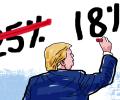
'Trump says India will buy over $500 billion of US goods.' 'At present, India's annual imports of goods and energy from the US are under $50 billion.' 'Reaching $500 billion would likely require more than 20 years, suggesting the figure refers to a long-term aspiration rather than a near-term commitment.'

Stock market is gearing up for an eventful week ahead where key triggers such as quarterly earnings from corporates, the US Fed interest rate decision and the upcoming Union Budget for 2026-27 would grab the limelight, analysts said.

Barring a few exceptions India has a chronic trade deficit with most of its existing FTA partners as it is with most of its proposed FTA partners.

India on Monday announced closure of negotiations for a free trade agreement signed with New Zealand, its 18th deal so far as the country aims to boost bilateral trade and investments. The India-New Zealand FTA is expected to be signed in the next three months and it is likely to come into force next year.

Guterres emphasised that global structures and institutions must reflect the complexity and the opportunity of the "new times and realities"

Finding solutions to address non-tariff barriers would be important for the proposed free trade agreement (FTA) between India and the European Union (EU) and both sides are actively working on resolving these issues, Commerce and Industry Minister Piyush Goyal said on Thursday. He said the two sides are "pretty" close to finalising the talks for the proposed free trade pact.

Government feels that early conclusion of Idnia-EU trade pact will open up new economic opportunities.

New Zealand has taken a binding commitment under its Free Trade Agreement (FTA) with India to amend its laws within 18 months of the pact's implementation to facilitate the geographical indication (GI) registration of Indian goods besides wines, and spirits in the island nation. The current GI law of New Zealand only allows India's wines and spirits to be registered.

India will not provide any duty concessions on British wines and is offering only limited import duty benefits on UK beer under the free trade agreement (FTA) between the two countries, announced on May 6, according to an official. The other sensitive agri products where India will not offer any reduction in the import duty include dairy products, apples, cheese, oats, animals and vegetable oils under the agreement with the United Kingdom.

India and Russia are poised to sign multiple agreements to bolster cooperation in various sectors, including trade and healthcare, during Russian President Vladimir Putin's visit to New Delhi. Discussions will also address the Ukraine conflict and efforts to increase Indian exports to Russia.

During the talks, both sides failed to reach on a conclusion and has agreed to meet again in June.

US Treasury Secretary Scott Bessent indicated a potential pathway to remove tariffs imposed on India for purchasing Russian oil, citing a significant decrease in such purchases. He also criticized Europe's approach and accused India of profiting from discounted Russian oil.

'...but I would not like to put a timeline to it'
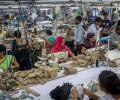
While the move may give a competitive edge over rivals like Bangladesh in the global market, several industry bodies raised concerns that many state governments may not implement it on the ground.

Maruti Suzuki will introduce eight SUVs over the next five years taking its overall model range to 28 as it aims to regain 50 per cent market share in the domestic passenger vehicle segment, Suzuki Motor Corporation Representative Director and President Toshihiro Suzuki said on Wednesday.

Stating the volume of trade between India and Finland is "not big enough", Finnish Minister for Foreign Trade Alexander Stubb today said it would increase only after signing of the much-talked about free trade agreement between India and European Union.

'I don't think we should ever negotiate with deadlines or hard stops because we tend to make mistakes then.'

India's gems & jewellery exports witnessed 30.6 per cent year-on-year (Y-o-Y) contraction in October to $2.17 million, amid the imposition of a steep 50 per cent tariff by the United States (US) on several Indian products.

'Our endeavour will be that we identify these products, put them in the public domain so that the manufacturers can look at them and give a boost to Make in India.'

The reduction in the goods and services tax (GST) rates has increased the momentum in India's economic activity both on the supply and demand sides, while robust agricultural activity - reflected in the strong onset of rabi sowing and adequate reservoir levels - has reinforced the outlook for food supply and rural incomes, the finance ministry said on Thursday.

So far 15 rounds of negotiations have been held.
European Union is not contemplating signing free trade agreement with India in the near future and will focus on completion of contentious World Trade Organisation negotiations including agriculture and Singapore issues
A meeting to discuss what goods should be included in the negative list of items for India-European Union Free Trade Agreement, was held here recently.
Industry body Assocham on Monday said country's top CEOs are in favour of signing a specialised free trade agreement with the European Union in services.

In a move that could improve the weakening sentiment in the Indian textile industry, the government is set to sign a free trade agreement (FTA) with the European Union (EU) by the end of the current calendar year.

India finalised a free trade agreement with the UK, its 16th so far as the country aimed at boosting bilateral trade and investments. The other regions and countries with which India has signed such agreements include the four-nation European bloc EFTA, Japan, Korea and Australia.
The talks are being held in Brussels between high-level delegations from India and EU, led by Commerce Secretary G K Pillai and Director General of European Commission Davis O'Sullivan.

India on Thursday signed a free trade agreement, officially dubbed as the Comprehensive Economic and Trade Agreement (CETA), with the UK - its 16th trade pact so far - as the country aims to boost bilateral trade and investments.

Says it is ready to show flexibility on all major issues

India's goods exports rebounded in July after two months of contraction, with outbound shipments rising 7.3 per cent to $37.24 billion, led by a surge in exports to the United States before the country's reciprocal tariff kicked in and bolstered by a recovery in exports to other key markets.
According to Indian officials, both the sides have had "fruitful consultations" regarding elimination of tariffs on 90-95 per cent of goods, but the EU's insistence on including non-trade issues, such as child labour, labour laws and climate change, in the trade pact are coming in the way of concluding an agreement.

'The government is actively engaging with EU to ensure that concerns of Indian companies and hard-to-abate sectors are adequately addressed under CBAM'
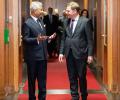
External Affairs Minister S Jaishankar has asserted that India has zero tolerance for terrorism and will never give in to nuclear blackmail, emphasizing that New Delhi will deal with Pakistan purely bilaterally. He made these remarks during a joint press conference with his German counterpart in Berlin, where he also highlighted the importance of the strategic partnership between India and Germany, emphasizing the need for a free trade agreement between the two nations.

The proposed India-European Union free trade agreement (FTA), which seeks to liberalise trade in goods and services, could be materialised by this year, EU Ambassador to India Joao Cravinho has said.
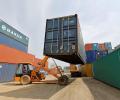
After registering a positive growth for two months, India's exports slipped into negative territory again, contracting 2.17 per cent year-on-year to $38.73 billion in May due to a fall in global petroleum prices, while trade deficit narrowed at $21.88 billion during the month.
India and the US desire to give preferential market access to each other's businesses and teams of both the countries are working together on the proposed bilateral trade agreement, Commerce Minister Piyush Goyal has said. In February, US President Donald J Trump and Prime Minister of India Narendra Modi announced plans to negotiate the first tranche or phase of a mutually beneficial, multi-sector Bilateral Trade Agreement (BTA) by fall (September-October) of 2025.

With US President Donald Trump "temporarily suspending" country-specific reciprocal tariffs until July 9, India sees the three-month window as an opportunity to renew its push for a proposed bilateral trade agreement (BTA) with the US and expedite finalisation of the first tranche of the trade deal.
 © 2026 Rediff.com - Advertise with us - Disclaimer - Privacy Policy - Sitemap - Feedback - About us - Terms of use - Grievances